
Introduction
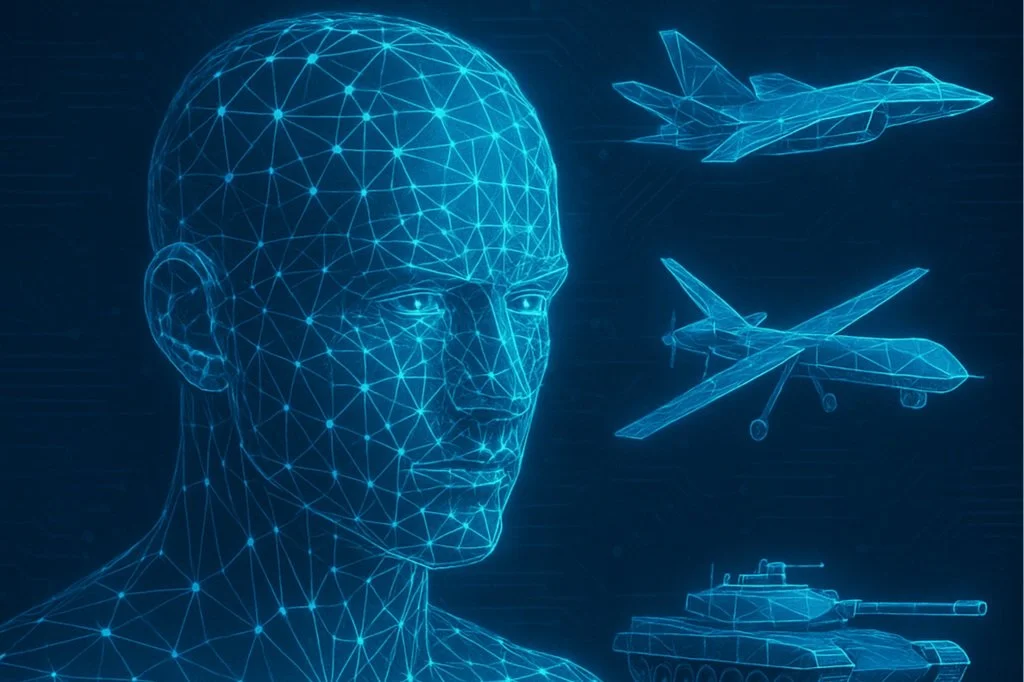
The convergence of Artificial Intelligence (AI) and Quantum Computing (QC) in military strategy represents a fundamental shift in warfare, similar to the merging of intercontinental ballistic missiles (ICBMs) with nuclear warheads in the mid-20th century. Just as past technological revolutions reshaped power structures, the synergy of AI and QC will determine future military superiority. This paper explores offensive and defensive applications across domains, emphasizing where the industry should concentrate to develop critical capabilities.
The New High Ground: The Strategic Convergence of AI and QC
Historically, dominance in warfare has relied on controlling the high ground, be it castles in medieval Europe, air superiority during World War II, or space in contemporary conflicts. Today, AI and QC establish this new high ground, offering an unmatched edge in decision-making speed, autonomous operations, and secure communications.
General John Hyten, former Vice Chairman of the Joint Chiefs of Staff, once stated, "Speed is the difference between victory and defeat." AI enhances speed, while QC disrupts cryptographic security, shifting the balance of power in ways that traditional defenses cannot counter.
Strategic Industry Focus: The Shift from Heavy to Smart Lethality
Military superiority was measured for decades by the ability to field large, expensive weapon systems. AI and QC shift this paradigm from mass and scale to speed, intelligence, and adaptability. Future warfare will prioritize light, lean, intelligent decision-capable, and lethal systems over expensive, monolithic platforms.
To lead in this new epoch, the defense industrial base must pivot toward the following priorities:
Autonomous & AI-Powered Combat Units
- Develop low-cost, networked autonomous drones, land vehicles, and naval units capable of decentralized operations.
- Reduce reliance on large, vulnerable platforms such as aircraft carriers and heavy armor in favor of swarming capabilities.
- Leverage QC's ability to calculate millions of contingencies in seconds, enabling autonomous units to outsmart and outmaneuver opponents in real time.
Quantum-Resistant & AI-Augmented Cybersecurity
- Invest in post-quantum cryptographic solutions to ensure secure military networks against quantum-based cyber threats.
- Deploy AI-driven cyber defense mechanisms capable of countering real-time adversarial AI attacks.
- Utilize QC to detect cyber threats at an unparalleled scale, anticipating attacks before they occur.
Hypersonic & AI-Enabled Precision Weapons
- Focus on cost-effective hypersonic missile defenses that utilize AI for rapid target acquisition and interception.
- Develop autonomous missile guidance systems that optimize strike precision without human latency.
- Implement QC-powered computational models to anticipate countermeasures and maximize lethality in real time.
AI-Enhanced ISR & Decision-Making Systems
- Deploy AI-driven real-time battlefield analytics for adaptive military strategy.
- Use quantum-enhanced intelligence systems to optimize targeting and countermeasures dynamically.
- Implement multi-role, multi-mission platforms that leverage QC for real-time decision-making in contested environments.
AI & QC Space Dominance
- Build AI-optimized, quantum-secured satellite constellations capable of operating in GPS-denied environments.
- Develop quantum-based space surveillance and early warning systems to counter adversarial orbital threats.
- Utilize QC-enhanced AI for dynamic space battle management, enabling autonomous defensive and offensive space operations.
Advanced Supply Chain & Logistics Optimization
- Implement quantum-AI hybrid systems for resilient, decentralized military logistics.
- Automate logistics operations to minimize human errors and reduce sustainment costs.
- Use QC-powered simulations to anticipate supply chain vulnerabilities and optimize real-time deployment strategies.
Positioning for Leadership in the AI-QC Epoch
The defense industrial base must transition from a legacy of producing heavy, expensive weapon systems to developing adaptive, intelligent, and cost-effective military solutions. The keys to leadership in this new era are:
- Multi-Role, Multi-Mission Platforms: Future battlefields will demand adaptable systems that can be repurposed rapidly based on emerging threats.
- Investing in Dual-Use Technologies: Companies that blend military and commercial AI-QC applications will outpace traditional defense contractors.
- Fostering Rapid Prototyping & Agile Development: Nations must adopt commercial best practices such as lean manufacturing and AI-accelerated design cycles.
- Building an AI-Quantum Talent Pipeline: Governments must invest in STEM education and workforce development.
- Leveraging Private Sector Innovation: Defense leaders must collaborate with private AI-QC startups, leveraging rapid innovation cycles.
Lessons from History: The ICBM-Nuclear Warhead Convergence
Historically, significant technological convergences, such as the combination of ICBMs with nuclear warheads, fundamentally altered strategic deterrence. AI and QC represent a similarly crucial shift. Just as nuclear weapons made conventional conflicts between superpowers impractical, AI and QC will redefine deterrence strategies and military power projection.
Former Secretary of Defense Robert Work observed that "whoever masters AI will rule the battlefield." The same applies to QC, as it will determine control of cyber, intelligence, and strategic warfare.
Final Thoughts: The Critical Need for Data Assurance
In the AI-QC epoch, data security equates to national security. Without reliable, tamper-proof data, every autonomous system, decision-making algorithm, and quantum-enhanced combat capability becomes untrustworthy, exposing forces to cyber warfare and disinformation tactics. Data integrity is the foundation for AI-driven military intelligence, QC-enabled logistics, and strategic command decisions.
Failing to secure data in this new era would be like entering modern battle with spears and bows against opponents armed with precision weapons. Without quantum-secured communications, AI-validated intelligence, and post-quantum cryptography, even the most advanced AI-QC systems will be compromised before they can take action.
The defense industrial base must prioritize data assurance, embedding end-to-end quantum cryptography, AI-powered anomaly detection, and secure provenance tracking into every military system. Nations that lead in securing military and intelligence data will dominate the AI-QC battlefield. Those who fail to prioritize data security will fight wars they have already lost before the first shot is fired.
Conclusion
AI and quantum computing are set to transform military strategy across all domains. The offensive potential is immense, with AI-driven autonomy and quantum computing-enabled cryptographic disruption reshaping battlefield dynamics. Defensive measures must adapt to counter these threats, ensuring resilience amidst rapid technological advancements. The global competition to develop AI-quantum military capabilities will shape future geopolitical power structures, making investment in these technologies a national security priority.
The true high ground of 21st-century warfare is no longer physical terrain, it is the ability to harness AI and QC for strategic and tactical supremacy.