
Executive Summary
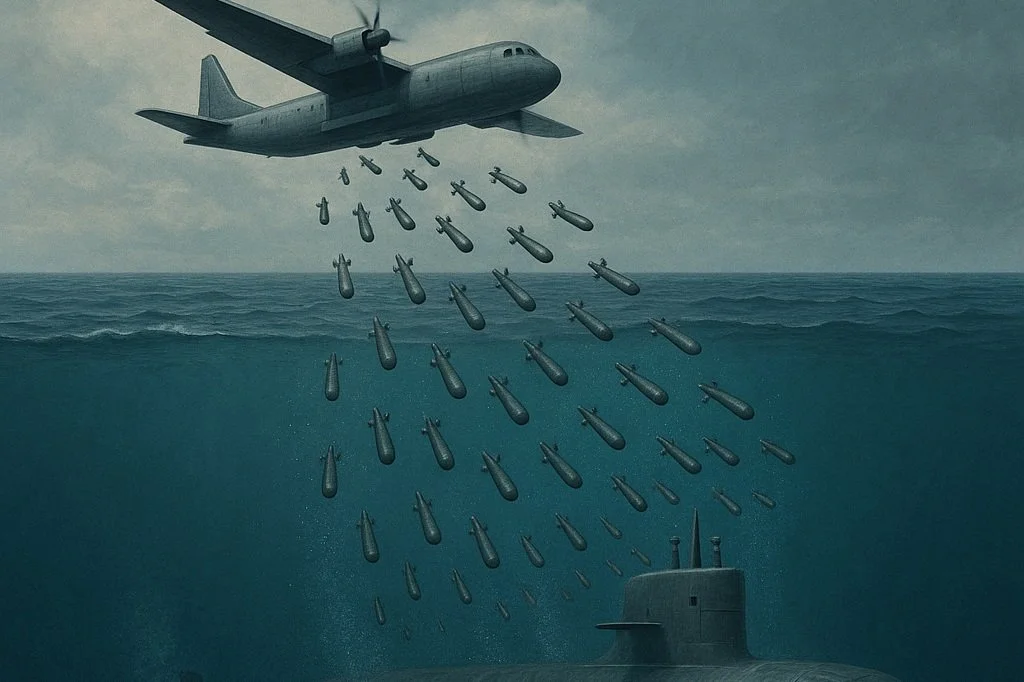
The future maritime battlespace will be characterized by the erosion of traditional stealth, the dominance of quantum sensing, and the increasing lethality of hypersonic strike capabilities. The U.S. Navy, historically defined by its technological superiority, faces an existential threat if it fails to adapt.
China's quantum detection advancements threaten the invisibility of our submarine fleet, the cornerstone of second-strike deterrence. Similarly, stealth aircraft like the F-35, once viewed as virtually undetectable, are becoming vulnerable to emerging quantum radar technologies. Meanwhile, hypersonic weapons and cyber warfare compress reaction times, bypass defenses, and cripple the Navy's reliance on network-centric warfare.
This paper argues that the Navy must enact a revolutionary shift: abandoning the concentration of power in massive, detectable platforms in favor of distributed, resilient, autonomous networks. Drawing lessons from history's great naval inflection points, Tsushima, Pearl Harbor, and the Falklands, it is clear that technology dictates doctrine, not the other way around.
The new "From the Sea" doctrine must embrace dispersion, autonomy, deception, quantum resilience, and cyber survivability. The United States can maintain maritime superiority in the Advanced Tech Epoch only through aggressive adaptation. Evolution is no longer sufficient; a revolutionary transformation is imperative.
Problem Definition
Legacy Assumptions
Cold War assumptions of invulnerability through technological superiority no longer hold. Visibility equals vulnerability in a battlespace dominated by quantum sensors and hypersonic strikes. Carrier strike groups and stealth aircraft formations can no longer assume survivability.
Emerging Threats
Quantum sensor networks can detect underwater anomalies at standoff distances, eroding submarine stealth. Advances in quantum radar and gravitational field detection also threaten low-observable aircraft like the F-35, reducing their operational utility in contested environments. Hypersonic missiles, capable of maneuvering at Mach 5+, bypass current air and missile defenses. Meanwhile, cyberattacks target shipboard systems, logistics pipelines, and battlefield awareness.
Vulnerability of Traditional Platforms
Large, centralized, signature-heavy platforms, such as Ford-class carriers and SSBNs, are now prime targets. If detected by quantum sensors and attacked by hypersonics, they may be rendered ineffective or destroyed early in conflict, resulting in strategic paralysis.
Strategic Analysis: The End of the Platform-Centric Era
Historical Evolution
At Tsushima (1905), wireless communications and superior maneuvering rendered the Russian fleet obsolete. Pearl Harbor's devastation of battleships in 1941 elevated the aircraft carrier to dominance. In the Falklands War (1982), precision missile strikes highlighted the vulnerability of surface ships. Each event demonstrated that technological shifts rapidly redefine naval strategy.
New Principles of Naval Power
Maritime power now requires dispersion, deception, autonomous adaptability, quantum resilience, and cyber survivability. Massed, detectable fleets are liabilities. Survival and dominance demand distributed, intelligent, and rapidly maneuverable forces.
Requirements for Future Success
The future Navy must:
- Deploy mass, modular autonomous forces.
- Employ quantum-resilient communications.
- Harden logistics through blockchain authentication.
- Ensure swarm tactics through AI-enhanced C2.
- Field cheap, fast-replaceable unmanned systems.
- Maintain deception dominance across all domains.
Recommendation: A New "From the Sea" Doctrine
Distributed Deep-Sea Deterrence: Deploy deep-diving, nuclear-powered unmanned underwater vehicles (UUVs) capable of extended patrols at abyssal depths. These platforms must operate autonomously, carry strategic payloads, and communicate only intermittently through quantum-resilient systems, ensuring survivability against quantum detection.
Airborne Hypersonic Nuclear Adjuncts: Integrate hypersonic glide vehicles onto platforms such as the B-21 Raider, dispersing strategic strike capability across highly mobile, hard-to-detect air units rather than concentrating it aboard vulnerable surface ships.
Decentralized Naval Power Projection: Transition carrier strike groups into flotillas composed of unmanned, low-signature platforms operating in distributed formations, leveraging autonomous coordination and quantum-secured communications.
Drone and UUV Swarm Saturation: Deploy hundreds of low-cost, expendable drones and UUVs to saturate enemy defenses, confuse targeting sensors, and create cognitive overload on adversary battle networks.
Stealthy Mobile Maritime Launch Platforms: Develop semi-submersible or fully submerged mobile platforms capable of launching hypersonic and cruise missiles. Their mobility and stealth will offer unpredictable strike options and complicate adversary targeting.
Quantum Countermeasures and Deception: Invest heavily in technologies that spoof, scramble, or overwhelm quantum detection arrays. Quantum noise generation, entangled decoy signatures, and gravitational anomaly masking must be core components of fleet survivability.
Resilient Command and Control Networks: Field distributed, quantum-encrypted, blockchain-secured command and control (C2) networks. These networks must self-heal, reroute under attack, and provide units operational autonomy when communications are compromised.
Rebalancing the Investment Portfolio: Reduce emphasis on multi-billion-dollar high-signature platforms. Shift investments toward rapid production of unmanned surface vessels (USVs), UUVs, hypersonic weaponry, and decentralized C2 infrastructure.
Implications for Allies and Adversaries
Distributed systems offer seamless opportunities for allied integration. Partner nations such as Australia, Japan, and the UK can operate autonomous units plugged into a shared C2 grid. Interoperability will increase combat resilience and complicate adversary planning.
Conversely, adversaries like China and Russia must commit greater resources to search and track widely dispersed U.S. and allied forces, stretching their surveillance and strike networks thin. This generates operational friction and strategic paralysis, forcing adversaries into a reactive posture.
Risks and Mitigation
Transitioning to autonomous, decentralized operations carries risks: unpredictable AI behavior, loss of human oversight, and system fragility under attack. These must be mitigated with hardened fallback protocols, human-in-the-loop authorities for critical decision points, and rigorous autonomous platform validation.
Cyber vulnerability expands with networked forces. Quantum-secured communication must be mandatory at every layer. Blockchain-driven data authentication must protect not just operations but logistics, maintenance, and intelligence streams.
Legacy procurement models and industrial base inertia present obstacles. Strong leadership, clear communication of threat realities, and aggressive pilot programs demonstrating autonomous operations' effectiveness will be crucial.
Conclusion and Prediction
The navies that survive and dominate will operate as dispersed, self-healing, quantum-resilient networks. Massed fleets will become death traps. Distributed autonomous swarms, shielded by quantum deception and sustained through resilient logistics, will control the sea, air, and information domains.
The U.S. Navy must lead a revolution as profound as the shift from sail to steam or battleship to carrier. The reimagined "From the Sea" doctrine must embrace stealthy dispersion, persistent deception, agile logistics, and autonomous operations to secure maritime superiority deep into the Advanced Tech Epoch.
Key Takeaways
- Naval strategy must evolve urgently to survive the quantum and hypersonic threat environment.
- Quantum detection renders stealth submarines and stealth aircraft increasingly vulnerable.
- Hypersonic weapons neutralize traditional layered fleet defenses.
- Cyber warfare now targets operational and logistics networks.
- Massed, high-signature platforms (e.g., carriers) are strategic liabilities.
- Distributed, autonomous maritime operations offer resilience and adaptability.
- Quantum-secured, blockchain-authenticated C2 and logistics must underpin future operations.
- Allies can be integrated seamlessly into decentralized formations.
- Procurement must emphasize speed, modularity, and rapid replacement over prestige platforms.
- Revolutionary change—not incremental adaptation—is essential for survival and dominance.