
Introduction
Since the end of World War II, the character of war has fundamentally shifted. The era of unconditional surrender, where one government completely collapses before another, is largely over. Modern conflicts are no longer settled by total defeat and occupation but instead result in fragmented, ambiguous conclusions. Wars now manifest as extended aggressions across multiple domains: kinetic violence, diplomatic isolation, economic pressure, and cyberattacks. Examples from Bosnia, Kosovo, Afghanistan, Iraq, Ukraine, and the ongoing Israel-Hamas conflict illustrate this evolution. This paper explores how war's transformation impacts international relations, the military-industrial complex, and the very concept of victory.
From Total War to Persistent Aggression
In World War II, conflict ended with the total surrender of Germany and Japan. Governments fell, borders shifted, and occupations began under new international mandates. Since then, such complete capitulations have become rare. Instead, most conflicts now involve aggressive campaigns that inflict damage without resulting in a full overthrow or formal surrender.
Bosnia (1992–1995): The Bosnian War saw ethnic cleansing and extreme violence, but ended through diplomatic negotiations at Dayton, not by a conquering army forcing unconditional surrender. NATO air strikes pressured Serbia, but the Serb government survived. A peace agreement froze ethnic divisions rather than resolving them.
Kosovo (1999): NATO's air campaign forced Yugoslav forces to withdraw from Kosovo. Yet, Belgrade's government remained in power until internal political shifts years later. The conflict concluded with partial occupation (by NATO peacekeepers) and Kosovo's unilateral declaration of independence, not a traditional victory.
Afghanistan (2001–2021): Despite overwhelming military superiority, the United States and its allies never achieved full political transformation in Afghanistan. The Taliban was removed in 2001 but returned to power in 2021, demonstrating that battlefield success no longer translates to lasting political outcomes.
Iraq (2003–2011): Saddam Hussein's regime collapsed quickly, an exception to the general trend. However, Iraq's occupation revealed the challenges of modern war: instability, insurgency, and political chaos followed. Even when a government falls, sustainable peace and authority are no longer guaranteed.
Ukraine (2014–Present): Russia's invasions in 2014 and 2022 represent wars of aggression aimed at territorial seizure and political destabilization, but not necessarily full annexation or regime replacement. Crimea was annexed, but Ukraine's government remains defiant. The war grinds on with no clear end, illustrating a "frozen" state of semi-war, semi-peace.
Israel and Hamas (2023–Present): The ongoing conflict between Israel and Hamas may result in total occupation of Gaza. However, given Hamas' ideological nature and external support, even occupation may not equate to victory. The deeper issues, identity, legitimacy, regional politics, remain unresolved.
New Forms of Aggression
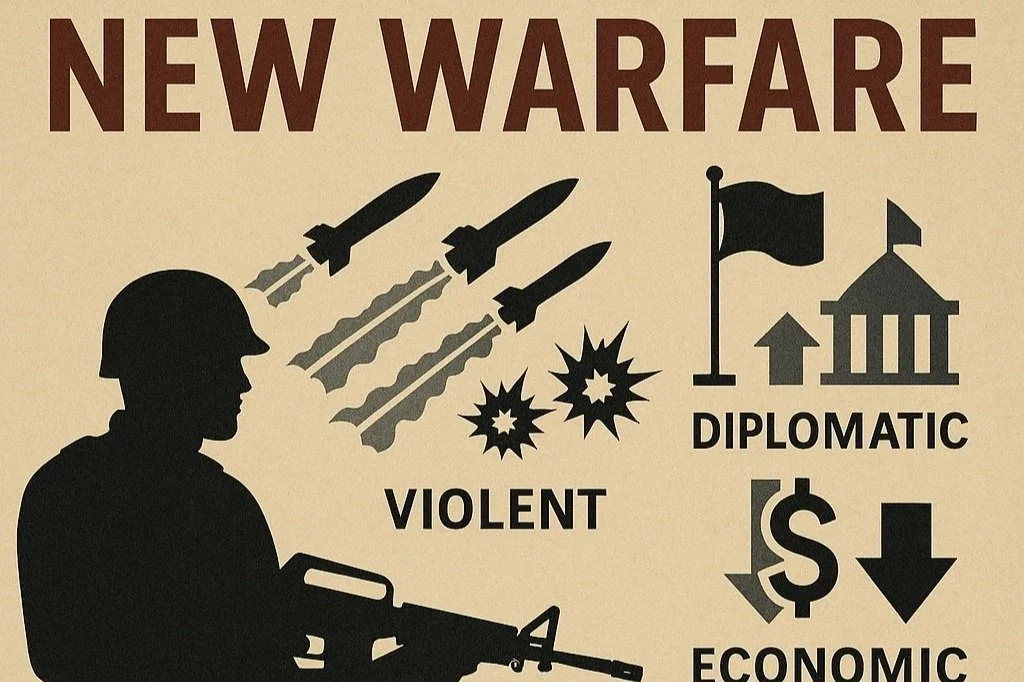
Modern war is conducted across multiple fronts, not just on the battlefield:
- Violent Aggressions: Bombardments, drone strikes, special operations (e.g., U.S. Navy SEALs against al-Qaeda).
- Diplomatic Aggressions: Expulsions of diplomats, recognition withdrawals (e.g., countries withdrawing ambassadors from Russia after the 2022 invasion).
- Economic Aggressions: Sanctions (e.g., U.S. and EU sanctions against Iran), trade tariffs used strategically (e.g., U.S.-China trade war).
- Cyber Aggressions: State-sponsored hacking (e.g., Russian cyberattacks on Ukraine's power grid, North Korean hacking of Sony Pictures), doxing, ransomware targeting critical infrastructure.
Each form of aggression seeks to weaken an opponent without risking the costs of full-scale war. These tools create a condition of persistent hostility without requiring a formal declaration of war.
The New End States: Frozen Conflicts and Saving Face
Modern conflicts often end not with decisive victory, but with a face-saving compromise, an armistice, or simply by running out of energy to continue. Key characteristics include:
- Frozen Conflicts: Ceasefires without treaties, unresolved territorial disputes (e.g., Korea, Ukraine, Nagorno-Karabakh).
- Saving Face: Publicly acceptable outcomes are crafted to avoid humiliation even in practical defeat (e.g., U.S. withdrawal from Afghanistan framed as "ending the forever war").
- No Formal Occupations: Peacekeeping forces replace occupation armies (e.g., NATO troops in Kosovo, UN missions in Mali).
This approach minimizes political backlash at home while allowing conflicts to simmer indefinitely.
Implications for the Military-Industrial Complex
The changing nature of war has deep consequences for defense industries and military planning:
- Continuous Demand for Arms: Persistent low-level conflicts create ongoing demand for weapons, drones, cyber capabilities, and surveillance systems rather than massive armies.
- Shift Toward Cyber and Space: Investment is growing in cyber tools, satellite defense, and electronic warfare rather than tanks and large fleets alone.
- Private Military Companies (PMCs): The blurred lines of conflict have expanded the role of PMCs like Wagner Group or Academi (formerly Blackwater), who operate in gray zones where traditional military actions would be diplomatically costly.
- Endless Upgrades: With no decisive victories, militaries constantly need newer, more adaptable technology to match evolving threats (e.g., anti-drone systems, cyber countermeasures).
Thus, the military-industrial complex thrives not on winning wars but on sustaining the ability to wage endless, evolving campaigns.
Conclusion
War in the 21st century has shifted from clear-cut victories to an ambiguous world of frozen conflicts and multifront aggressions. Governments avoid the total overthrow of adversaries, preferring diplomatic isolation, economic strangulation, cyber harassment, and selective strikes to achieve objectives without triggering broader wars. Victory is now a murky concept, often defined by endurance rather than triumph. For the military-industrial complex, this shift means a steady, continuous demand for flexible, high-tech capabilities rather than the overwhelming force of past wars. Understanding this transformation is essential for preparing future national strategies, alliance structures, and peace negotiations in an increasingly unstable world.