
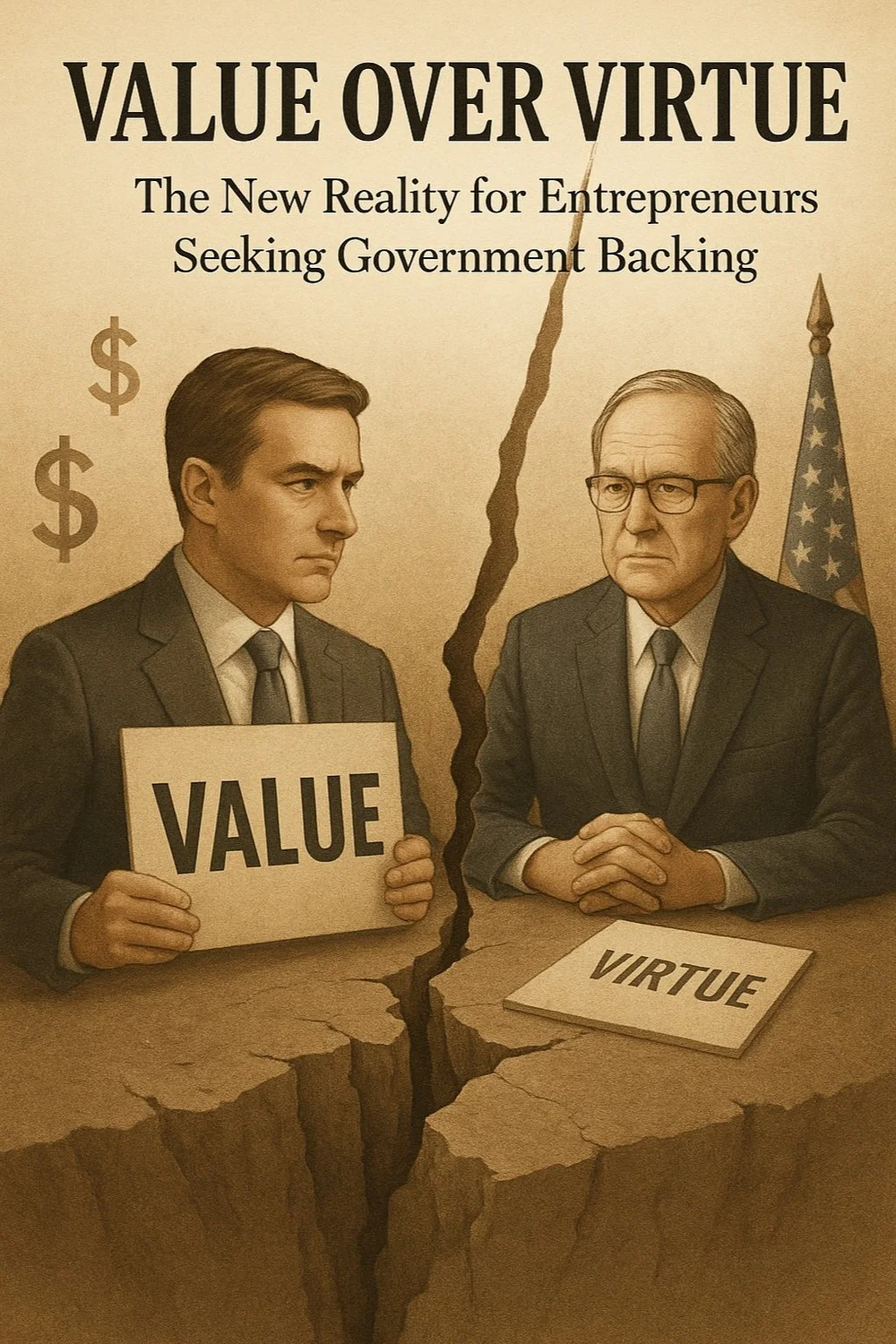
We are living through a tectonic shift in how the federal government defines what is worth supporting. Gone are the days when signaling virtue was a ticket to favor. Today, the game has changed. The new rule for entrepreneurs and business owners hoping to win federal grants, contracts, or investments is clear: show measurable value or be left behind.
This is not a philosophical argument. It is a strategic one. Under the new administration, value creation is king, especially value that aligns with national priorities like defense, supply chain resilience, AI leadership, energy independence, and infrastructure. You may be mission-driven. You may have a socially conscious business model. You may be advancing equity, sustainability, or ethics. However, you are unlikely to see significant federal support unless you can prove ROI, cost savings, security benefits, or scalable impact.
Let us be honest. Virtue used to be its own currency. Especially in the last administration, being aligned with ESG narratives or social impact messaging could unlock grant funding, media coverage, and government interest even before a product proved its worth. But the shift has come. The current administration does not oppose virtue but sees it as ornamental rather than foundational.
As a business owner, this means retooling your pitch, not your principles. Suppose your solution promotes sustainability, great. Now show how it cuts costs for the Department of Defense or increases yield for the Department of Agriculture. If you are building AI that helps underserved populations, even better. But now frame it in terms of readiness, resilience, or operational advantage. You need to show how your product solves a government pain point better, faster, or cheaper than the alternatives.
This does not mean abandoning mission or integrity. It means adapting your messaging and priorities to survive in today's climate. Virtue without value is vapor, but value without virtue can still win contracts.
Meanwhile, states like New York and California are doubling down on virtue signaling. They are creating parallel economies where ESG and DEI are still paramount. But do not be fooled. They are doing it less as an authentic stand and more as a political statement, a way to defy the federal tide. The stance of "our state, our rules" plays well on local stages, but in the long term, it risks losing access to the vast pool of federal innovation dollars that are now flowing in a different direction.
Businesses rooted in those states must prepare. Either tailor your solutions to federal language or risk being shut out from Washington's checkbook.
Here is the bottom line for entrepreneurs:
- Clarify your value proposition. What mission-critical problem do you solve?
- Frame your solution in terms of national interest, economic impact, or operational efficiency.
- Stay mission-driven, but lead with measurable outcomes.
- Target agencies that now hold funding authority: Defense, Commerce, Energy, Homeland Security.
This is not just a political cycle. It is a redefinition of the business-government relationship. Entrepreneurs who understand the shift and position their innovations as essential infrastructure, not ideological statements, will thrive.
In this new world, virtue may win headlines, but value wins funding. Choose wisely.